From Ernest Rutherford to a Physics Degree: What Can You Study at the University of Canterbury?
Have you ever wondered how people investigate things they cannot directly see—atoms, waves, energy, or particles? One name that often appears in that story is Ernest Rutherford. But his value for prospective students is not simply a list of historical achievements. His story shows that Physics begins with curiosity, precise questions, experiments, and the willingness to test an idea.
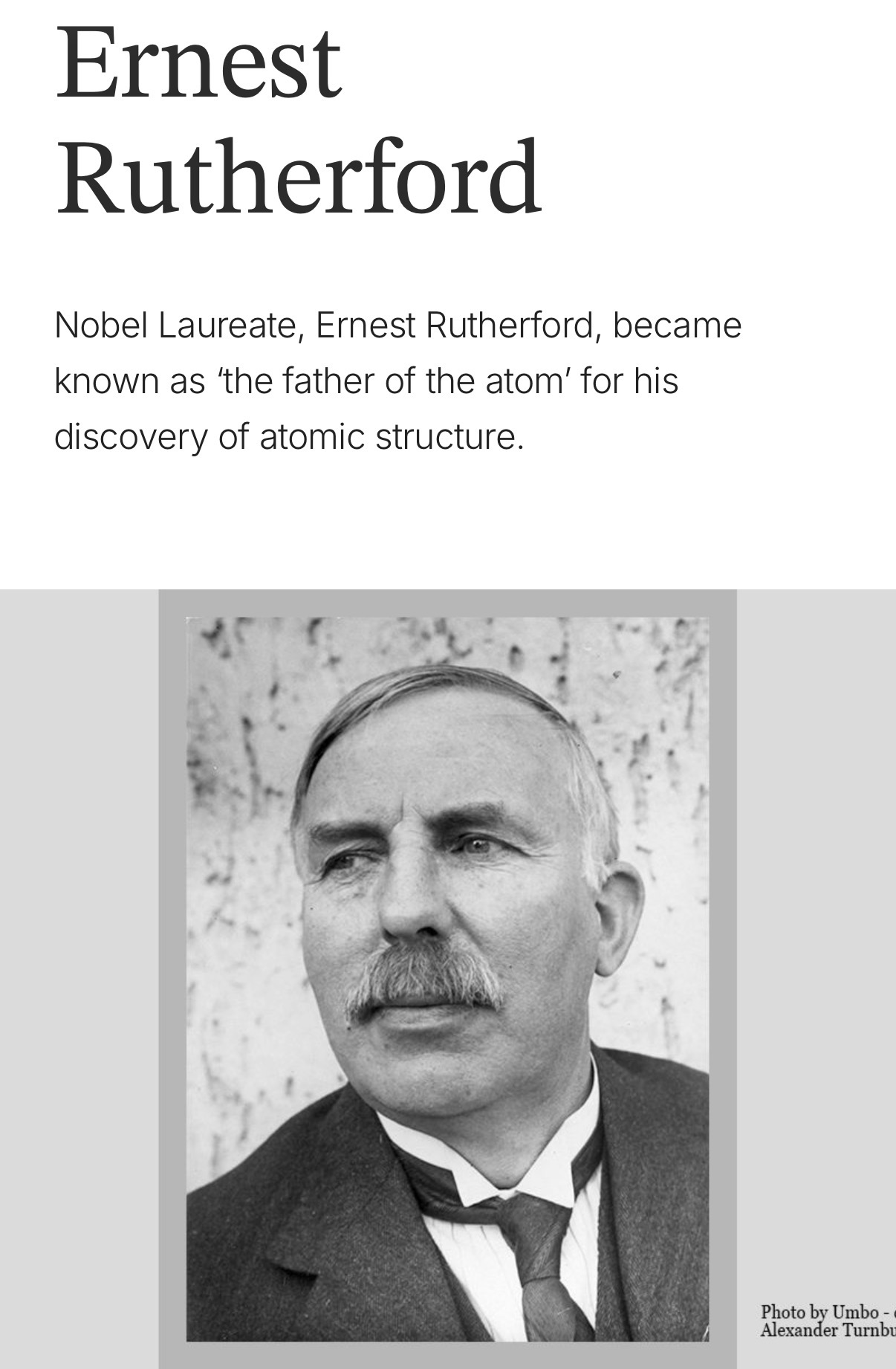
Rutherford left Canterbury College with three degrees in 1895, then continued research at Cambridge’s Cavendish Laboratory. The University of Canterbury records that he investigated radioactivity, named alpha and beta rays in 1898, received the 1908 Nobel Prize in Chemistry, and later developed the nuclear model of the atom.[1] This is historical context, not a career template every student must follow.
Physics is more than formulas
Physics studies the relationship between matter and energy, from the subatomic scale to the universe.[2] So students do not only learn to solve equations. They also learn to build models, test assumptions, read data, design experiments, and explain conclusions clearly.
At the University of Canterbury (UC), Physics study includes laboratory experiments, fieldwork, and computing skills. UC lists facilities such as a nano lab, superconducting magnet lab, cloud chamber, and cryogenics lab; its named research areas include Medical Physics, Nanotechnology, and Cosmology.[2] Facilities and offerings can change, so always check the latest programme information before applying.
What does a Physics pathway include?
UC’s Physics major sits within the Bachelor of Science. Early study includes mechanics, waves, electromagnetism, thermal physics, modern physics, mathematics, and introductory programming.[2] This connection between Physics, Mathematics, and computing matters: many modern physics problems need to be expressed as mathematical models, then tested with calculations or data.
At advanced level, listed examples include thermal, statistical and particle physics; quantum mechanics; advanced electromagnetism and materials; and advanced experimental physics and astronomy.[2] UC also notes that students can deepen areas such as condensed matter, nanotechnology, environmental physics, medical physics, laser physics, astrophysics, or theoretical physics.[3]
So Physics does not have to end in a narrow picture of working only in a particle laboratory. Your interest may move toward health technology, materials, energy, the environment, space, data, or the principles behind everyday devices.
Skills you can build
Physics students commonly practise how to:
- break a large problem into a testable model;
- use Mathematics to explain phenomena;
- work with data, coding, and uncertainty;
- design or run experiments carefully;
- communicate findings and limitations scientifically.
These skills are useful, but they do not automatically guarantee a specific job. UC lists potential directions including experimental research, scientific consulting, technology development, IT and electronics, aerospace, science centres, and research and development.[2] Your eventual path still depends on course choices, experience, further study, country of work, and any applicable professional requirements.
Who may enjoy this field?
Physics can suit students who enjoy Mathematics and Science, want to understand why things work, and are comfortable learning step by step when a concept feels abstract. School-level Mathematics and Physics preparation is helpful. UC specifically recommends introductory Physics and Mathematics for students who have not taken both to Year 13 or final secondary-school level.[2]
UC’s Bachelor of Science also frames observation, experimentation, modelling, and calculation as ways to understand and improve the natural world.[4] If you are drawn to big questions, analytical work, and practical investigation, Physics may be a pathway worth exploring.
RIM Education can help you compare overseas Physics, Applied Physics, Medical Physics, Astronomy, or Engineering options. Contact RIM Education for an initial discussion.
Sources
[1] https://www.canterbury.ac.nz/about-uc/why-uc/our-alumni/uc-legends/ernest-rutherford — University of Canterbury: Ernest Rutherford [2] https://www.canterbury.ac.nz/study/academic-study/subjects/physics — University of Canterbury: Physics undergraduate subject [3] https://www.canterbury.ac.nz/study/academic-study/science/science-schools-and-departments/school-of-physical-and-chemical-sciences/study-in-the-school-of-physical-and-chemical-sciences/study-physics — University of Canterbury: Study Physics [4] https://www.canterbury.ac.nz/study/academic-study/qualifications/bachelor-of-science — University of Canterbury: Bachelor of Science