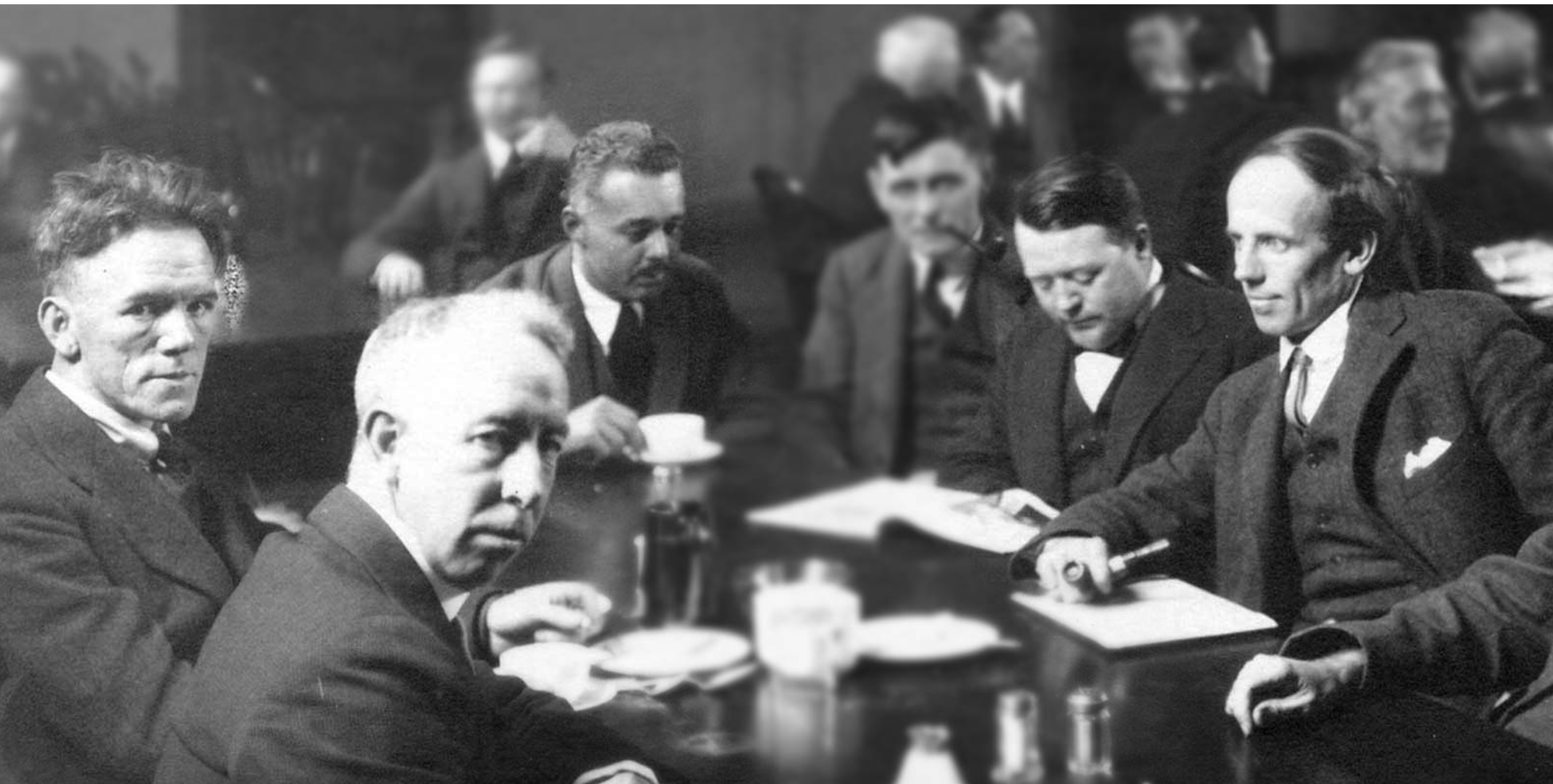
If you are considering an art degree in Canada, the Group of Seven is a name that often appears in conversations about the country’s visual-art history. The painters first exhibited under the name Group of Seven in Toronto in 1920, remained active during the 1920s, and officially disbanded in 1933.[2]
They are known for bold landscapes: lakes, forests, hills, northern skies, and simplified natural forms shaped with expressive colour and brushwork. Rather than simply “painting scenery”, their work helped define debates about what modern Canadian art could look like.[1][2]
Who were the Group of Seven?
The seven founding members who exhibited in the early show were Franklin Carmichael, Lawren Harris, A. Y. Jackson, Frank (Franz) Johnston, Arthur Lismer, J. E. H. MacDonald, and F. H. Varley.[1][2] Membership changed over time, with A. J. Casson, Edwin Holgate, and LeMoine FitzGerald joining later.[1]
Tom Thomson is often associated with the Group and was an important inspiration, but he died in 1917—before the group’s first exhibition. Emily Carr was also closely connected artistically, though she was not an official member.[1][2]
What can future art students learn?
The Group of Seven can be a useful starting point for learning how to look, not a style to copy. When studying a work, ask:
- How does the composition guide the eye through trees, hills, water reflections, or the horizon?
- How does colour build mood instead of only recording natural colour realistically?
- Which forms are simplified or exaggerated to make the landscape feel more dramatic?
- What changes between a fast oil sketch and a more resolved studio painting?
These questions are relevant to Fine Arts, Illustration, Visual Communication, animation background design, Photography, and Art History. Museums also show sketches alongside finished oils, allowing visitors to consider the relationship between field observation, experimentation, and developing an artwork.[2]
Studying art also means reading context
Appreciating visual technique does not mean ignoring historical context. The Art Gallery of Ontario notes that many Group of Seven depictions romanticised Canada as an uninhabited place, despite the presence of Indigenous communities and industry in the regions the artists visited.[2]
This is an important lesson for future art students: images are not only about aesthetics. Choices about place, viewpoint, who is visible, and who is left out also shape meaning. In studio critique, art history, and visual research, you can learn to connect close visual observation with ethical and contextual questions.
From the gallery to your study plan
If you are considering creative study in Canada, use museum collections as material for developing portfolio direction or a personal statement—not for copying a style. Note the works that hold your attention, explain the visual elements you observe, then connect them to your own interests: landscape, colour studies, visual storytelling, printmaking, or art education.
Arthur Lismer, a founding member, was also an arts educator. In 1929, he ran Saturday-morning art classes at the Art Gallery of Toronto that encouraged children to express themselves rather than merely copy an instructor’s techniques.[2] It is a useful reminder that art education involves thinking, experimenting, receiving feedback, and developing a creative voice.
RIM Education can help you compare Fine Arts, Design, Illustration, Animation, and Art History programmes in Canada, including portfolio and application-document requirements. Contact RIM Education to discuss your plans.
Collection, programme, and admission information can change. Always check the official museum and destination-institution websites before making decisions.
Sources
[1] https://thegroupofseven.ca — The Group of Seven — Canadian landscape painters from 1920 to 1933
[2] https://ago.ca/collection/group-of-seven-ago — Group of Seven at the AGO — Art Gallery of Ontario