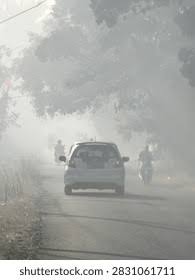
From Haze to Clean Water: Degrees That Can Address Indonesia’s Real-World Challenges
When reports of haze and clean-water difficulties appear, it is understandable to feel that the problem is too large for one student to influence. Yet choosing a degree can start with a simple question: what problem do I want to understand and help address?
This article does not use residents’ circumstances as spectacle or promise that one degree can solve everything. It is a reminder that environmental and health challenges require many kinds of expertise working together—from weather data to infrastructure design, and from disease prevention to risk communication.
Why does this need a cross-disciplinary view?
BMKG provides extreme air-quality early warnings based on PM2.5 and forecasts for haze-particle dispersion. This means monitoring and decision-making need knowledge of the atmosphere, data, and how to communicate information to the public.[1]
The impact is also more than a hazy sky. Indonesia’s Ministry of Health reported that land and forest fires in 2026 contributed to an air-quality crisis and an increase in acute respiratory infection cases in affected areas; the response involved health workers, logistics, monitoring, and protective-behaviour guidance.[2] Challenges like this do not have one “correct” degree. They need a team with different roles.
1. Environmental Engineering and Water Systems
If you are curious about how water moves, is stored, treated, and kept safe, Environmental Engineering can be a relevant route. The field combines science and technology to design solutions involving climate change, water resources, energy, and environmental-risk management.[3]
Questions you may explore include: how can we design more resilient water systems? How can water be treated, pollution reduced, or infrastructure kept functional as environmental conditions change? Look for a curriculum with foundations in mathematics, chemistry, hydrology, water treatment, modelling, and design projects—not only a programme name that sounds “green”.
2. Environmental Science, Geography, and Climate Science
Do you enjoy understanding the relationship between weather, land, people, and ecosystems? Environmental Science, Geography, or Climate Science may fit. These paths help students read systems: climate patterns, land use, environmental quality, risk maps, and change across a region.
Useful skills to look for include GIS or spatial mapping, remote sensing, data analysis, fieldwork, and evidence-based reporting. These capabilities help ensure environmental information does not remain as numbers alone, but can become maps, recommendations, and action plans people can understand.
3. Public Health and Epidemiology
If your question is closer to “how can people be protected when the environment deteriorates?”, consider Public Health. This field examines disease prevention, health promotion, evidence analysis, and response planning at a population level.[4]
In an air-quality context, students can learn to consider who is more vulnerable, how health data is interpreted, how services prepare, and how health messages can be clear without being alarming. Public Health is not the same as clinical medicine; its focus is population health, systems, prevention, and evidence-based policy.
4. Data Science and information technology
Environmental challenges generate substantial data: air-quality readings, satellite imagery, weather forecasts, health reports, and maps. Data Science, or an IT route with an analytics focus, can help turn that data into dashboards, models, visualisations, or more usable warning systems.
Technology is not a stand-alone answer, however. Choose a programme that also teaches data ethics, results communication, and collaboration with environmental or health specialists. Strong code still needs to answer people’s needs on the ground.
How to choose without following a trend
Start with three personal lists:
- Problems that make you curious: water, air, health, maps, fire, or community behaviour?
- Ways of working you enjoy: experiments, design, field observation, speaking with communities, or data analysis?
- Skills you are willing to build: mathematics, biology, chemistry, coding, writing, or presenting?
Then compare course structures, electives, laboratories, field projects, and assessment types across several universities. Do not choose only because a degree title sounds relevant. The right path sits at the intersection of a problem you care about, a learning style that fits, and skills you are willing to practise consistently.
Indonesia needs more graduates who can work across disciplines: engineers who understand health impacts, data analysts who can communicate with communities, and health professionals who can read environmental risks. If you want to map suitable study options abroad, RIM Education can help you build a shortlist and check entry requirements.
Air-quality conditions, water conditions, and response policies can change. For safety information during an active incident, follow BMKG, the Ministry of Health, and the relevant local authorities.[1][2]