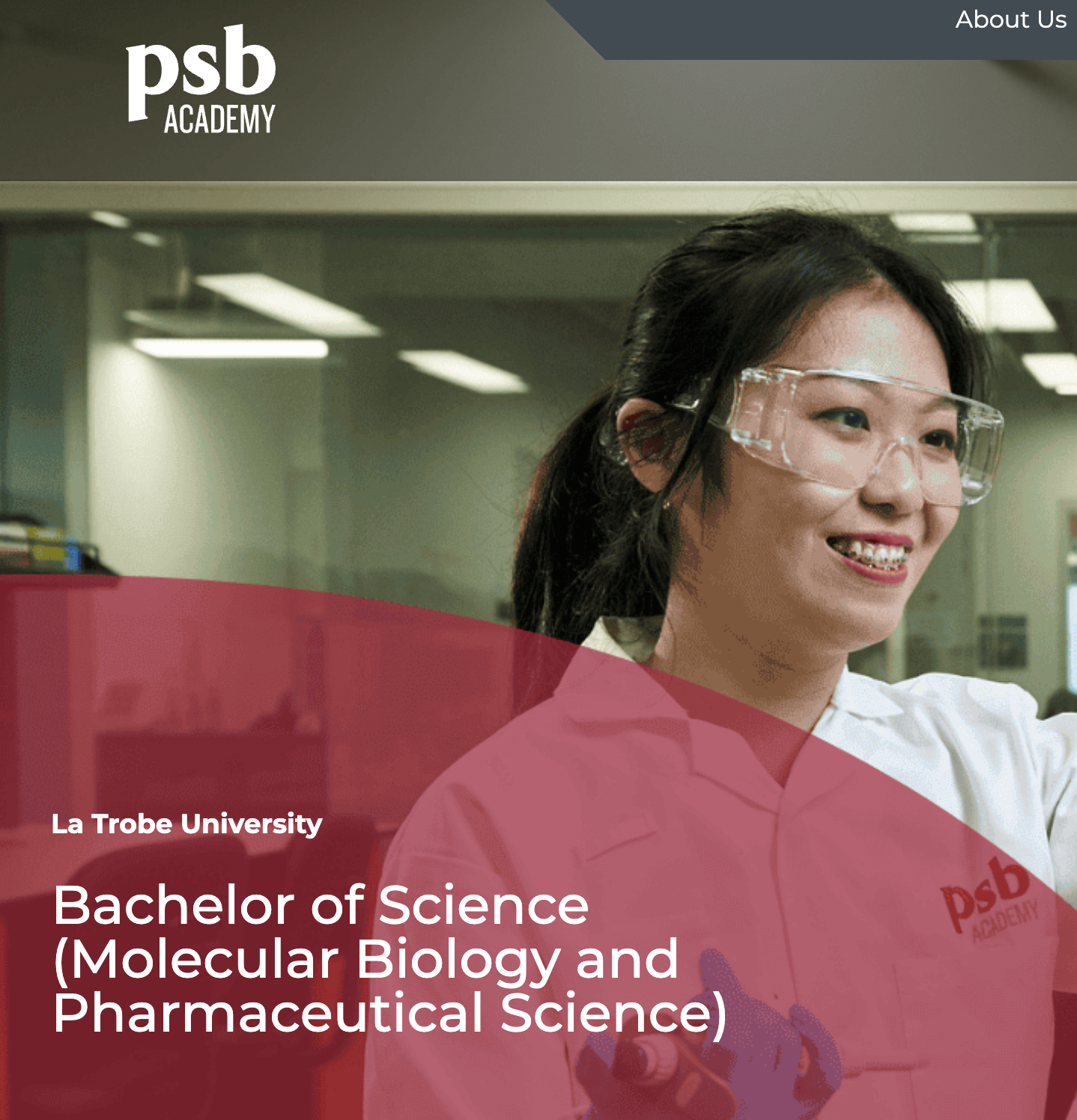
Study Applied Chemistry and Molecular Biology: La Trobe University at PSB Academy Singapore
Short answer: the Bachelor of Science (Applied Chemistry and Molecular Biology) promoted by PSB Academy combines molecular biology and applied chemistry within La Trobe University’s Bachelor of Science located at Singapore (PSB).[1][3] It may suit students who want to study chemistry and biology at a molecular level, but a study decision should follow a check of the structure for your chosen intake, credit recognition, written fees and current entry conditions.
Who delivers the course and awards the degree?
La Trobe’s handbook identifies Singapore (PSB) as the course location and PSB Academy Singapore as the partner provider.[3] PSB’s course page places the programme in its La Trobe University portfolio.[1]
The clearest identity for prospective students is therefore: a La Trobe University Bachelor of Science delivered with PSB Academy in Singapore.[1][3] Keep the degree-awarding institution separate from the delivery partner when comparing options, checking an offer or asking admissions questions.
How are Applied Chemistry and Molecular Biology structured?
La Trobe’s 2026 handbook states that the Bachelor of Science – Singapore (PSB) totals 360 credit points. Under the SBSCSI structure, students complete 60 core credit points, 105 credit points in a Molecular Biology major, 75 elective credit points and 120 credit points in a second major.[3]
On that page, Molecular Biology must be the primary major; Applied Chemistry is available as the second major in a double-major combination.[3] PSB describes relevant areas including drug design, organic synthesis, medicinal chemistry and forensic science, together with synthesis and laboratory work in analytical, physical or computational chemistry.[1]
In other words, this is more than combining two subject labels; the official double-major structure and learning outcomes include science foundations and scientific practice.[3] Students should be comfortable with laboratory practice, data analysis and scientific communication.
Which skills can you develop?
La Trobe identifies scientific thinking, scientific communication, lab and fieldwork skills, problem-solving, collaboration and professional conduct as course learning outcomes.[3] PSB also refers to principles across inorganic, organic, physical, biological, analytical, computational, materials and macromolecular chemistry.[1]
Those skills can be relevant for further study or for exploring roles in laboratory, research, chemical-industry and related settings.[3] The degree does not automatically provide professional registration, placement, employment or a work permit. Ask about scope of practice and any required certification in the country where you hope to work.
What should you understand about duration and fees?
Two pieces of information should be read carefully. PSB lists a 28-month full-time duration and possible 12–18 month completion depending on exemptions; La Trobe’s 2026 handbook lists three years full-time for the Bachelor of Science – Singapore (PSB).[1][3]
The different presentations may relate to credit recognition, intake structure or the basis of calculation, so they should not be assumed to apply identically to every student.[1][3]
For international students, PSB’s 2026 prospectus lists course fees inclusive of 9% GST as S$53,628 for the full programme, S$40,221 for 18 modules and S$26,814 for 12 modules.[2] The document is labelled 2026; fees, GST, module exemptions and application/administration charges can change. Request a written quotation or offer for your intake and entry route before planning funding.[2]
Are placements or career pathways guaranteed?
No. The handbook describes Work Based Learning opportunities as elective; some subjects may require students to source their own placement, include an application and Subject Coordinator approval, and vary by location and hours.[3] Do not treat WBL, an internship or employment as an automatic result of enrolment.[3]
La Trobe lists examples of career directions including pharmaceutical scientist, chemist, medical scientist and research scientist.[3] Use these as prompts for exploration, not as promised job titles or career outcomes.
Application checklist
- Confirm the award title, partner-delivery arrangement and study location in a written offer.[1][3]
- Request the module map and Applied Chemistry second-major structure for your intended intake.[3]
- Obtain a written assessment of prior learning or exemptions; do not assume that a shorter duration applies automatically.
- Separate tuition from GST, application and administration fees, insurance, accommodation, living costs and immigration documents; the referenced prospectus lists tuition and GST, not every personal cost.[2]
- Check academic, English-language and Singapore immigration requirements through current official sources at application time.
FAQ: Is this the same as Biomedical Science?
No. This is a Bachelor of Science with Molecular Biology as the primary major and Applied Chemistry as the second major in the handbook structure.[3] PSB lists it separately from the Bachelor of Biomedical Science.[1]
Compare subject lists, assessment, the capabilities you want to develop and your postgraduate goals before choosing.[1][3]
Next step
Need help preparing questions about modules, credit exemptions, fees or application documents? Contact RIM Education. We can help organise your questions and application preparation without promising admission, exemptions, a visa, placement or a career outcome.
Last checked: 20 November 2026. Intakes, module availability, duration, fees, entry requirements, recognition of prior learning and immigration rules can change; current official course information and a written offer are the final reference.